In 2025, Florida lawyer Nadia Mary Metroka was disbarred. The central concerns are punishment for invoking constitutional rights and the use of false accusations, hurtful rumor, and other highly prejudicial incorrect information by the Florida Bar with Keri T. Joseph as its then investigator and prosecutor.
Advocacy by Nadia Mary Metroka · Official court actions and legal sources linked below
People and institutions involved
The role. The conduct. The responsibility.
Metroka contends that the following conduct requires public accountability.
Former Florida Bar counsel
Keri T. Joseph
Role: Investigated and prosecuted the case, presented it to the Grievance Committee, and represented the Bar before the referee.
Actions at issue:
Brought disciplinary charges involving six incidents: a protest during the COVID-19 pandemic; speeding during a family emergency; a hypothetical sent to opposing counsel; an explanation of voir dire instructions; concerns about an arbitrator’s impartiality; and an email referencing religious beliefs.
Pursued discipline over the voir dire matter even though the presiding court expressly declined to report Metroka to the Florida Bar.
Before the Grievance Committee: Presented false police reports and other prejudicial and incorrect information to obtain probable cause.
Characterized a speeding incident as an arrest for reckless driving and withheld exonerating evidence.
Before the referee: Sought a default judgment, unsupported by law, after Metroka invoked constitutional defenses.
Presented false police reports from arrests that did not result in convictions, together with hurtful rumor and other highly prejudicial and incorrect information.
Elicited false testimony that Metroka sent a sexually harassing email, had been held in contempt of court several times, and had been evicted several times.
Presented prejudicial, uncorroborated hearsay as reliable, made arguments unsupported by law that the referee could consider it, and withheld exculpatory evidence.
Why accountability is imperative: Bar counsel must present accurate information, make legally supported arguments, respect constitutional rights, and protect the lawyer, clients, and public from unjust harm. It should be noted that Florida Statutes 837.011 and 837.06 and Florida Bar v. Committee make the subject conduct unlawful and grounds for criminal charges and professional discipline.
Referee
Judge Gregory Keyser
Role: Presided as referee and made findings and a disciplinary recommendation.
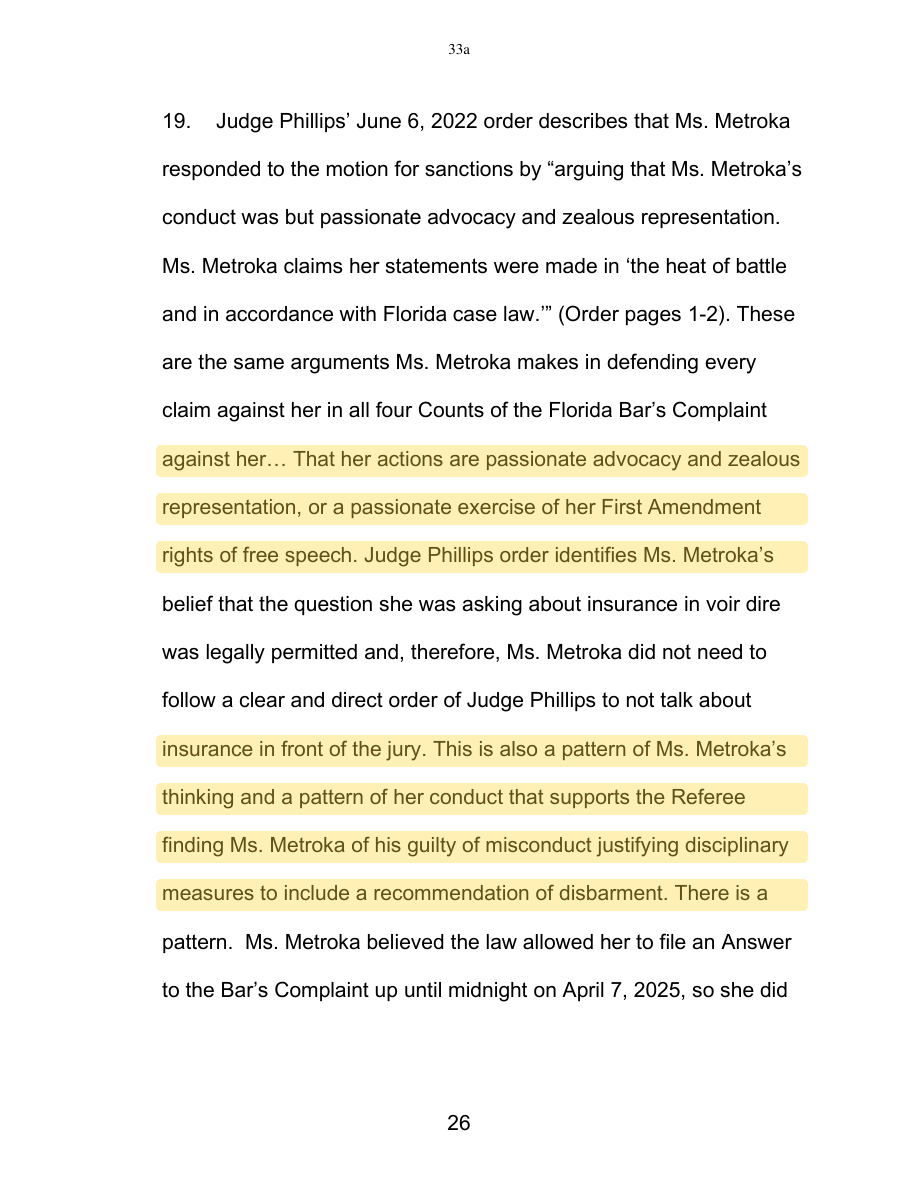
Conduct at issue: Keyser ignored exculpatory evidence, made findings unsupported by evidence, and found disbarment was justified because Ms. Metroka invoked the Constitution of the United States.
Referee’s report, page 26 (appendix page 33a). Select the image to view it full size.
Why accountability is imperative: Findings that affect the right to practice must rest on evidence and lawful grounds. The treatment of constitutional defenses and exculpatory evidence requires independent scrutiny. Penalizing a lawyer for invoking constitutional protections/federal law and thereby deterring lawyers from seeking to uphold and protect the Constitution of the United States is a direct attack on our infrastructure.
Testimony at issue
Charlie Greene
Role: Witness whose statements were used in the disciplinary proceeding.
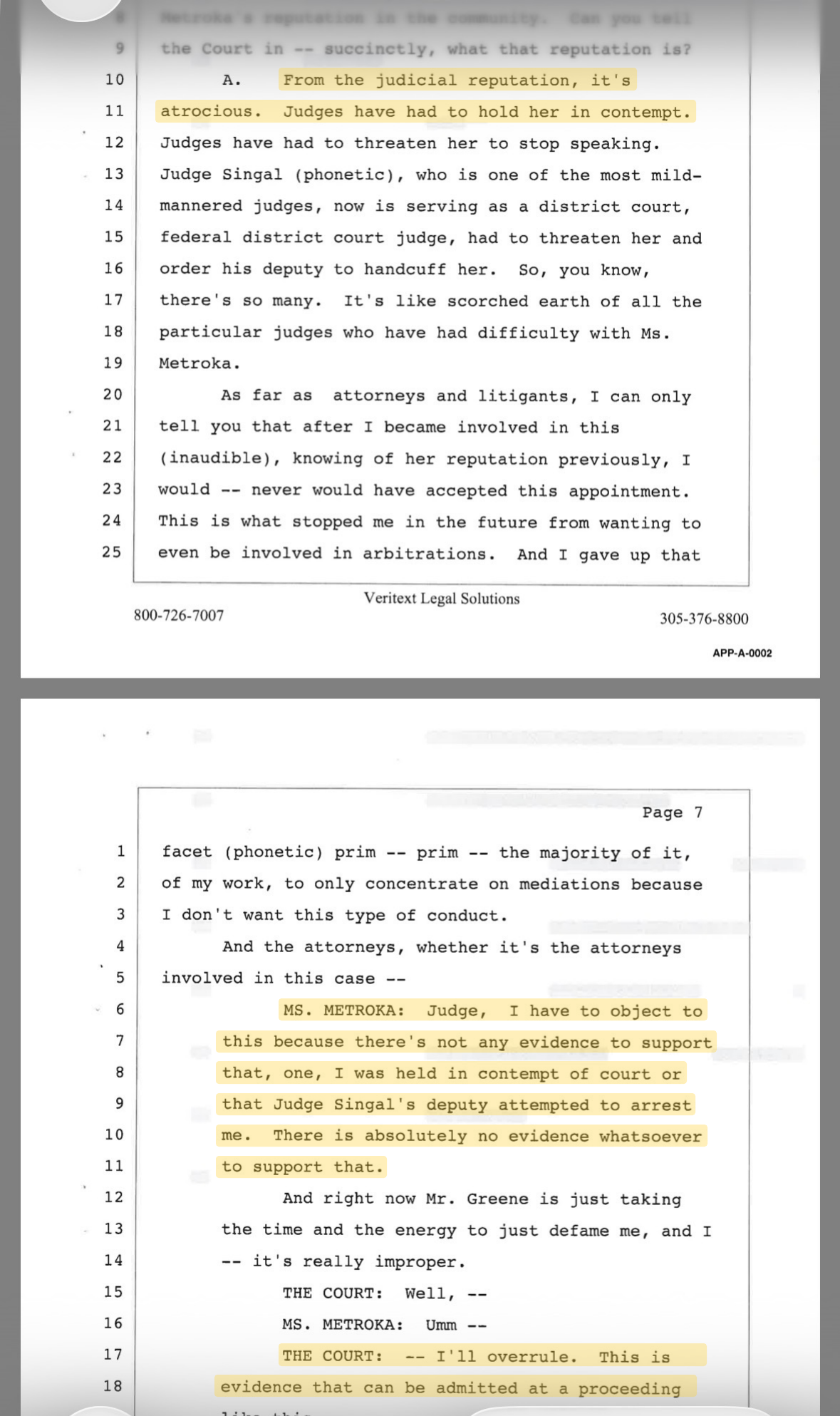
Conduct at issue: Filed a bad faith bar complaint alleging that Ms. Metroka impugned his qualifications and integrity after she filed a motion putting the Court on notice of believed bias/incompetence/fraud/collusion after Charlie Greene repeatedly made defamatory statements about Ms. Metroka during legal proceedings. Also, made false statements under oath during the proceedings including but not limited to the following: Metroka has been held in contempt of court several times (the Referee then found that Metroka needs to learn how to follow judicial orders—establishing that the subject statement was not made without causing significant harm), has been evicted several times, and her reputation is atrocious. Charlie Greene also repeated a comment stating that Metroka is “bats___t crazy.” Even though Charlie Greene’s testimony was inflammatory, abusive, and uncorroborated, Judge Keyser found Charlie Greene to be credible.
Why accountability is imperative: Factual testimony must be tested against actual court orders and case outcomes. Reputation judgments must be distinguished from provably false material statements under oath. It should be noted that Florida Statutes 837.011 and 837.06 and Florida Bar v. Committee make the subject conduct unlawful and grounds for criminal charges and professional discipline.
Opposing counsel · Active litigation
John H. Richards
Role: Opposing counsel in a case that was actively being litigated at the time. His testimony about her communications was also presented in the disciplinary proceeding. However, Mr. Richards has never reported Ms. Metroka.
Conduct at issue: Made claims that Ms. Metroka sent him a sexually harassing email asking if he and another older male lawyer were able to get sexually aroused. There was no documentary evidence presented to support this claim, i.e., the alleged email. Even so, that did not stop Keri T. Joseph from eliciting the subject testimony and attempting to corroborate it by claiming that Ms. Metroka thought she was in a relationship with Mr. Richards. This was a bizarre, insane, and absurd attempt to discredit Ms. Metroka by seeking to make her look unstable as was the other false testimony.
It should be noted that Florida Statutes 837.011 and 837.06 and Florida Bar v. Committee make the subject conduct unlawful and grounds for criminal charges and professional discipline.
Opposing counsel · Active litigation
Conley
Role: Opposing counsel in a case that was actively being litigated at the time.
Conduct at issue: Filed a bad-faith Bar complaint against Metroka claiming she was threatening him after the two conferred via email that she was not- did so for purposes of gaining leverage in proceedings that were actively being litigated. Keri T. Joseph withheld the subject communications thereby attempting to alter evidence for purposes of claiming that the subject email (that started with “using your logic”) was a threat.
Why accountability is imperative: The attorney-disciplinary process must not be used as a litigation tactic. A Bar complaint filed by opposing counsel to gain leverage undermines the integrity of both the disciplinary system and the underlying judicial proceeding.
Disciplinary institution
The Florida Bar
Role: Investigated and prosecuted the disciplinary matter. Its stated lawyer-regulation responsibility is to protect the public from unethical lawyers.
Conduct at issue: The use of false information and unsupported arguments, together with the failure to address reports of misconduct within the institution.
Why accountability is imperative: Public-protection authority demands scrutiny of the institution’s own lawyers and leadership. The demand for independent investigation extends to the Bar itself.
State court · Recorded disposition
Supreme Court of Florida
Role: Entered the disbarment order on January 22, 2026, approving the referee’s uncontested report in SC2024-1794. The Florida Supreme Court refused to review the constitutionality of the disbarment because Ms. Metroka was unable to purchase the transcript from the sanctions hearing even though the issues in this matter are on the face of the report.
Why scrutiny is imperative: The order imposed the consequence affecting Metroka and her clients. The handling of review, constitutional objections, and the underlying findings is central to the demand for accountability. Under the 1st Amendment, the Courts are not permitted to make justice contingent upon ability to pay.
Federal review · Recorded dispositions
United States Supreme Court
Role: Declined to review a matter involving the constitutional rights of lawyers and the Florida courts’ failure to enforce constitutional protections. The Court denied certiorari on May 4, 2026, and rehearing on October 5, 2026, in Metroka v. The Florida Bar, No. 25-7012.
Why public scrutiny is imperative: The denials left the state judgment in place without a Supreme Court merits decision addressing the constitutional objections or the Florida courts’ refusal to enforce those protections.
The demand is for public examination of the failure to grant review and its consequences for constitutional protection.
Prosecutorial review · Palm Beach County
Alan Johnson
Role: Chief Assistant State Attorney with the Office of the State Attorney for Florida’s Fifteenth Judicial Circuit, serving Palm Beach County.
Conduct at issue: Alan Johnson refuses to investigate and bring charges concerning the conduct described on this page, citing his position that the Florida Bar is a private entity.
Why public scrutiny is imperative: The public deserves a state attorney’s office that investigates public corruption and holds the state actors accountable not protect them by claiming they are a private entity.
Public harm
A public-protection system must protect the public.
What makes this case especially concerning is that the conduct at issue came from within the institution entrusted to protect the public from unethical lawyers. The Florida Bar is supposed to safeguard the integrity of the legal profession—not engage in the very conduct its disciplinary authority exists to prevent. When a public-protection system uses false information, unsupported legal arguments, and disciplinary power to punish the invocation of constitutional rights, the resulting harm reaches far beyond a single lawyer or proceeding.
The damage extends to clients who lost their chosen counsel, people who depended on Metroka to protect their rights, and every member of the public who must be able to trust that legal institutions will act lawfully and truthfully. Disbarment disrupts representation, limits access to counsel, and deprives clients of continuity and choice. False information and unsupported findings also weaken confidence in the courts, the legal profession, and the rule of law itself.
This reversal of a public-protection mission reflects conduct associated with authoritarian legal systems in which government power displaces due process, constitutional protections become meaningless, and institutions meant to protect the people instead become instruments of oppression. Accountability must therefore reach every person who presented, relied upon, or disregarded the false information, as well as every institution responsible for oversight. Protecting the public requires independent scrutiny, meaningful consequences, and safeguards capable of preventing this conduct from happening again.